Categories

Blog posts about QNAP's products and technologies.
Whether deployed in an enterprise environment, a creative studio, or an advanced homelab, every storage system has the same essential mission: to keep data safe, reliable, and accessible over the long term.
As data continues to grow, storage systems commonly face the following challenges:
The design of QuTS hero NAS is centered on addressing these challenges.
QuTS hero uses ZFS end-to-end checksums to generate verification data for every data block. Each time data is read, the system verifies it against the recorded checksum. If the values do not match, QuTS hero can immediately detect a data integrity error.
In addition to verifying data during read operations, QuTS hero supports scheduled Pool Scrub. Pool Scrub proactively scans data blocks in the Storage Pool for corruption or inconsistencies, helping identify potential issues before the affected data is accessed.
When redundancy is available, QuTS hero can repair a damaged block after detecting a checksum error. This self-healing capability helps protect against silent data corruption.
For administrators, maintaining data integrity no longer relies primarily on manual checks. Checksum verification, scheduled Pool Scrub, and self-healing work together to provide continuous data protection.
Data integrity is only one aspect of long-term storage reliability. As data volumes grow and random read/write activity continues, a storage system must also maintain efficient capacity utilization, consistent performance, and SSD endurance.
Built on the ZFS architecture, QuTS hero includes multiple optimizations for storage efficiency, write performance, and SSD lifespan, helping reduce performance degradation and administrative overhead during long-term operation.
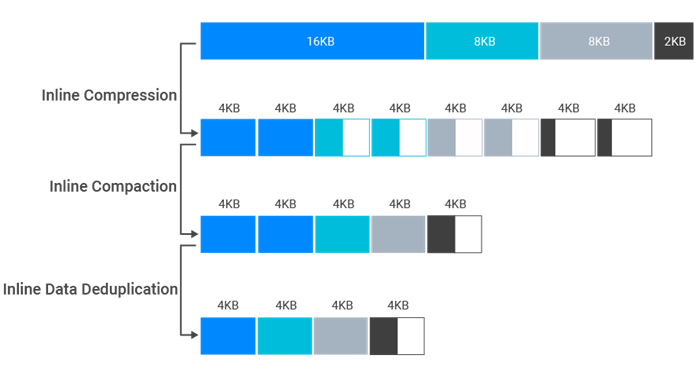
ZFS supports inline compression, which shrinks large files to smaller sizes, helping to reduce the actual I/O load on backend storage and achieve accelerated access. However, compression may not fully occupy a block, leaving unused space.
QuTS hero Inline Compaction further assembles fragmented data into complete blocks before writing them to disk. By reducing wasted block space, it improves overall storage efficiency.
Many workloads generate large numbers of small, fragmented writes. This not only increases the amount of data written to SSDs, but can also reduce long-term SSD durability.
To address this challenge, QuTS hero uses QNAP’s proprietary Write Coalescing algorithm. It organizes scattered and random data into sequential order, consolidating write blocks to minimize read and write operations, reducing random-write overhead and unnecessary SSD wear.
While SSD lifespan is determined by a finite number of writes, it is possible that several SSDs in the same RAID reach their end-of-life at the same time, causing a RAID crash with data loss.
QNAP’s patented QSAL (QNAP SSD Antiwear Leveling) technology continuously monitors SSD health. When SSD lifespan drops below a defined threshold, QSAL dynamically adjusts SSD over-provisioning to prevent simultaneous multi-SSD failures.
For administrators, this enables SSDs to be replaced in stages rather than having multiple drives reach end of life simultaneously, helping reduce RAID rebuild risks and simplify system maintenance.
QuTS hero snapshots use the ZFS Copy-on-Write (CoW) mechanism, enabling fast snapshot creation without disrupting active workloads. Real-time SnapSync continuously synchronizes data from the primary NAS to a secondary NAS for near-real-time protection.
Using block-level synchronization, the primary and secondary NAS can maintain a nearly identical data state over time. If the primary system becomes unavailable, the secondary NAS can quickly take over services, minimizing both data loss and downtime.
QuTS hero also supports up to 65,536 snapshots, giving administrators greater flexibility to retain historical versions based on their data protection requirements.
Note: Real-time SnapSync is designed for low-latency network environments. See the Best Practices for the configuration of Realtime SnapSync.
QuTS hero continually optimizes essential storage protocols. SMB supports SMB Multichannel, allowing data to be transferred simultaneously over multiple network connections. This increases aggregate bandwidth and improves network fault tolerance, helping large-file and multimedia workloads make better use of available network resources.
In QNAP testing with four 2.5GbE connections and SMB Multichannel enabled, sequential read performance increased from approximately 295 MB/s to approximately 1,180 MB/s.
*Performance may vary depending on hardware and environment.
When QuTS hero is deployed as a dedicated storage platform, administration can remain focused on core storage services, including Storage Pool management, shared folder planning, access protocol configuration, and data protection.
After initial deployment, routine tasks such as Storage Pool health checks and snapshot retention can be automated on a schedule. Administrators can monitor system status through notifications while maintaining reliable storage services over the long term.
ZFS provides the foundation for data integrity, while QuTS hero adds optimizations for the practical challenges of long-term storage, including SSD lifespan management, real-time disaster recovery, and reliable file-service performance.
For environments that prioritize long-term data preservation and operational stability, the value of QuTS hero lies not in any single feature, but in its ability to maintain a reliable and easy-to-manage storage environment for years to come.
AI Disclosure: Some images and text in this article were created or refined with the assistance of Artificial Intelligence (AI) and reviewed by human editors.
