Categories
Blog posts about QNAP's products and technologies.
Imagine this scenario: Your Tier 1 automotive customer suddenly notifies you that they will conduct an annual quality audit next week. They require you to provide the complete production records for a batch of battery modules produced three years ago — including raw material receipt records, temperature and torque data from each process step, and the final quality inspection results.
Your system engineer retrieves the MES data from that period, only to discover a problem: the records are there, but some entries look like they were added after the fact. The customer’s auditor then asks a question that leaves the room silent: “How can you prove these records have never been tampered with?”
Since 2024, global automotive electronics standards (such as IATF 16949) and medical manufacturing regulations (such as 21 CFR Part 11) have increasingly mandated full traceability and auditable evidence across production processes. The 2026 EU supply chain regulations, such as ESPR/DPP, further mandate that certain industries (e.g., batteries) provide machine-readable, verifiable manufacturing traceability data. Regular database backups are no longer sufficient.
Many IT teams still think of data protection as just two things: snapshots and backups—snapshots for accidental deletion, backups for hardware failure. However, both approaches share a critical blind spot: they safeguard the existence of data, but not its integrity.
| Mechanism | Accidental Deletion Protection | Hardware Failure Protection | Tampering Protection |
| Snapshots | ✅ | ❌ (bound to the same device) | ❌ |
| Traditional Backups | ✅ | ✅ | ❌ |
| WORM Storage | ✅ | ✅ (with RAID) | ✅ Key Advantage |
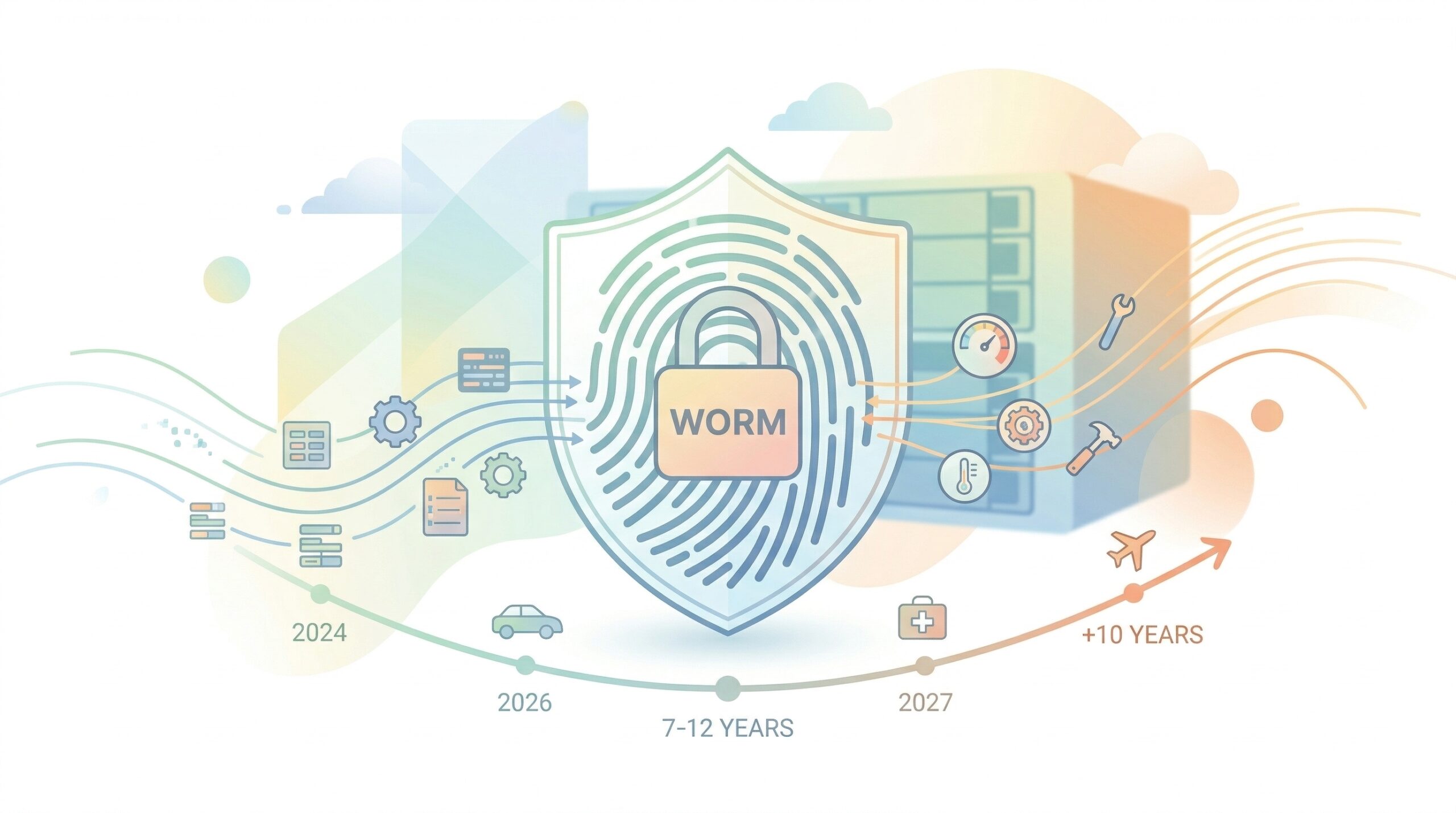
Write Once Read Many (WORM) is a technology that immutably locks data at the storage layer. Once data is written to a WORM-protected space, no one, no system, and not even users with administrative privileges can modify or delete it until the predefined retention period expires.
This is the “indisputable digital fingerprint” you can present at the table when facing strict regulatory audits.
QNAP offers WORM functionality across its enterprise-grade models, further addressing the needs of manufacturing companies of all sizes:
TS-h2477AXU-RP — QuTS hero solution for medium to large-scale facilities
The TS-h2477AXU-RP runs on QNAP’s QuTS hero operating system, leveraging ZFS (an enterprise-grade file system) as the underlying storage layer, and natively supports WORM-enabled shared folders.
QuTS hero WORM design highlights:
ES2486dc — QES enterprise-grade solution for high availability
The QNAP ES2486dc, featuring a dual-active controller architecture and running the QES operating system, also supports WORM-enabled shared folders. It is ideal for large-scale manufacturing environments that demand high availability and superior access performance.
The ES2486dc delivers enterprise-grade all-flash array performance, sustaining millisecond-level response times even under heavy synchronous read/write workloads across multiple production lines.
A standard WORM-enabled manufacturing compliance workflow is structured as follows:
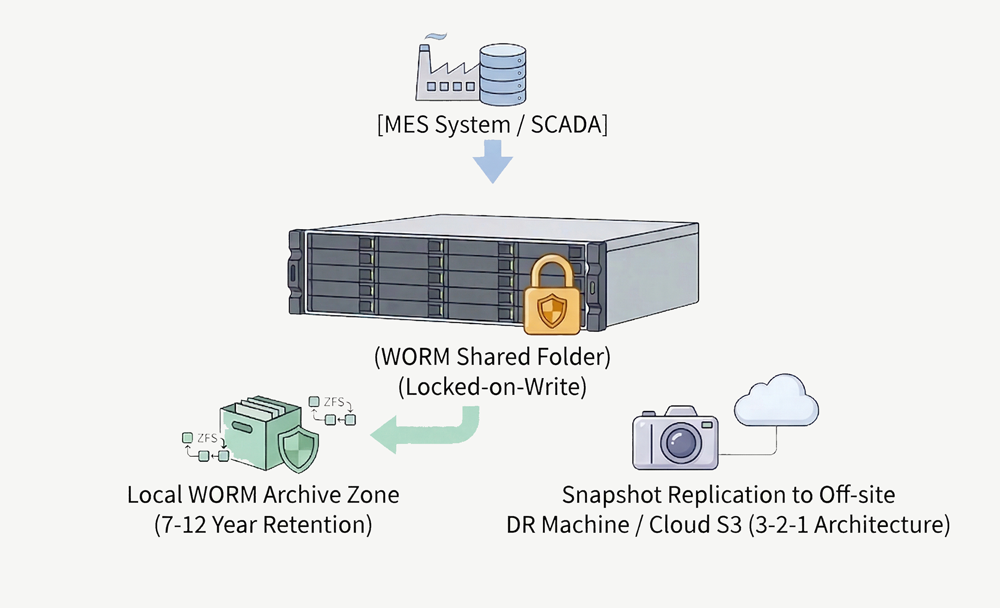
The key principle is that WORM protects the originally written data, while snapshots and backups ensure that the immutable record remains recoverable even in the event of hardware failure. The two mechanisms complement each other and are equally essential.
| Industry | Applicable Standards (Reference) | Recommended Minimum Retention Period |
| Automotive Electronics (EV/ADAS) | IATF 16949, some customers’ requirements | 7–12 years |
| Medical Device Manufacturing | ISO 13485, FDA 21 CFR Part 11 | 10–15 years |
| Aerospace Components | AS9100D | 15+ years |
| Electronics Manufacturing Services | IPC standards, customer contracts | 3–7 years, depending on contract |
⚠️ Note: The above table is provided for general reference only. Actual compliance retention periods should be guided by specific customer contracts and advice from legal counsel. QNAP’s WORM functionality supports customizable retention periods, enabling flexible configuration according to your needs.
The credibility of quality data is becoming one of the core competitive advantages in manufacturing. In the past, merely having backups was deemed adequate; from 2026 onwards, the critical question from customers will be: “Can you prove that this record has never been tampered with?”
WORM is not a high-barrier enterprise technology — it has long been built into QNAP’s QuTS hero and QES NAS storage platforms. What you need to do is factor in performance requirements and future data growth in your planning, evaluate your retention period requirements, and enable protection for critical production data folders.
Next time the auditor comes knocking, let the data speak — data untouched by anyone.
AI Disclosure: Some images and text in this article were created or refined with the assistance of Artificial Intelligence (AI) and reviewed by human editors.
